

From an early age I grew up and learned to write with Parker pens. For some special occasions, my gift was often a Parker pen. By the way, at that time I couldn’t remember any brands other than Parker or Waterman. The online offer was still non-existent and writing with a fountain pen was related to studying and processing learning material through writing. At that time (80’s and 90’s) there was no question of a fountain pen hobby.
At the start of my fountain pen hobby, I went back, probably nostalgically, to Parker. In the meantime, we have become so much wiser, or we think we are, that I honestly realize that Parker has not improved and seems to be stuck. The cheaper Parker fountain pens don’t excite me. I also notice that there is a lot of criticism within the fountain pen community and that other and new brands are praised to the heavens.

In essence, the once-great Parker now seems but a mere shadow of its former glory. Yet, there’s a sense of anticipation for a ‘but’ to counter this notion. And true enough, there emerges a beacon of excellence, a bastion of quality: the Parker Duofold, the undisputed monarch of the Parker realm.
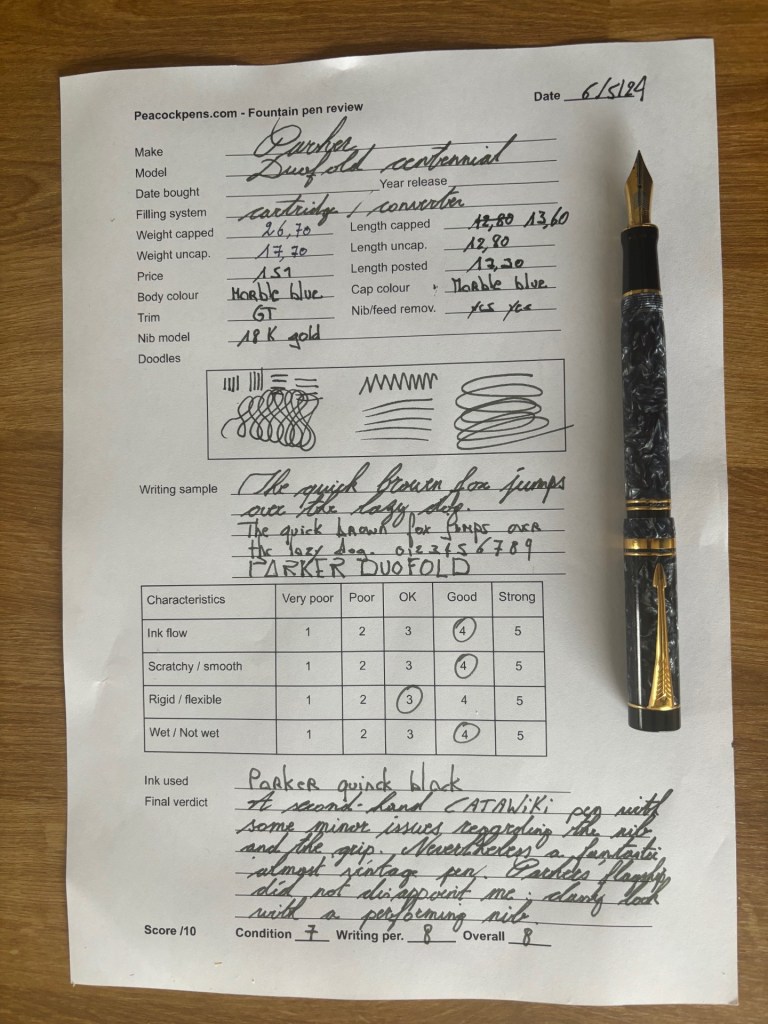
I often receive really positive reactions and stories from the Parker Duofold. Reviews are also promising and the Duofold is labeled as fantastic. I recently ventured into the world of vintage pens and, quite by chance, found myself winning a Parker Duofold Centennial at a Catawiki auction. Bidding on Catawiki is always an act of hope: hoping your bid is the winning one and that it remains unbeaten. In the end, my bid of 151 Euro was the winning bid and I received the pen a few days later. My Parker Duofold is the centennial edition in marble blue color with gold trims. The pen is equipped with an 18 carat gold nib. Buying second-hand always involves a certain risk in which photos are disguised. In my case, I am satisfied, the pen has slight signs of use, but no damage. A good buy?
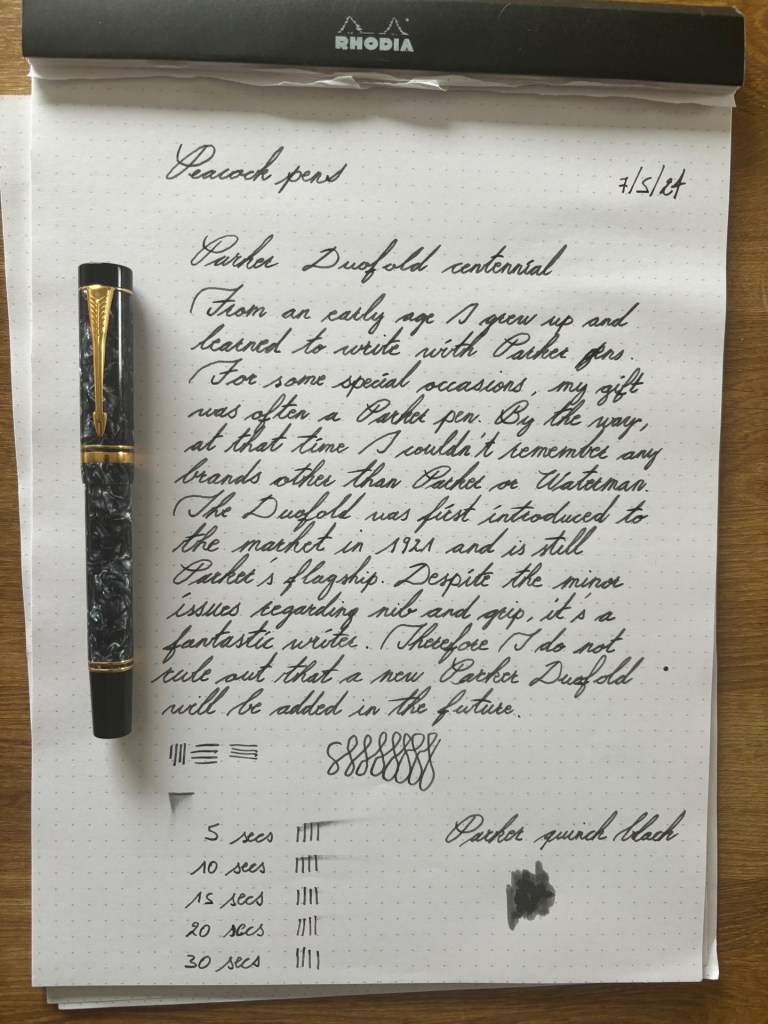
The Duofold was first introduced to the market in 1921 and is still Parker’s flagship to this day. In 1988, to celebrate their 100th anniversary (1888-1988), Parker released the centennial edition, the Duofold MKI.
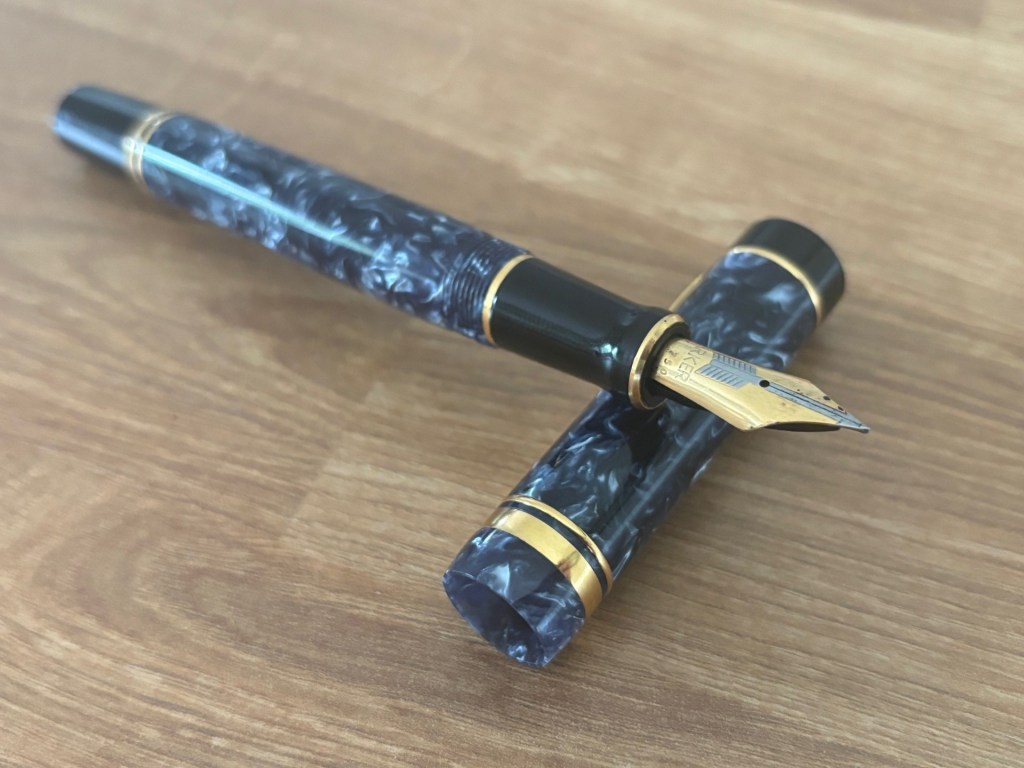
The Parker Duofold is a big guy clearly recognizable to his flat tops. The twist cap with gold band needs two turns to open. The cap can be used in a posted way but it does make the pen long and the balance shifts. For me, it’s just possible. The cap has the typical Parker chevron clip. This clip is not the original but the clip with raised relief and has been designed to be bent 100.000 times without losing its spring. Parker introduced this clip in 1990. This clip is also a bit longer than the first centennials.
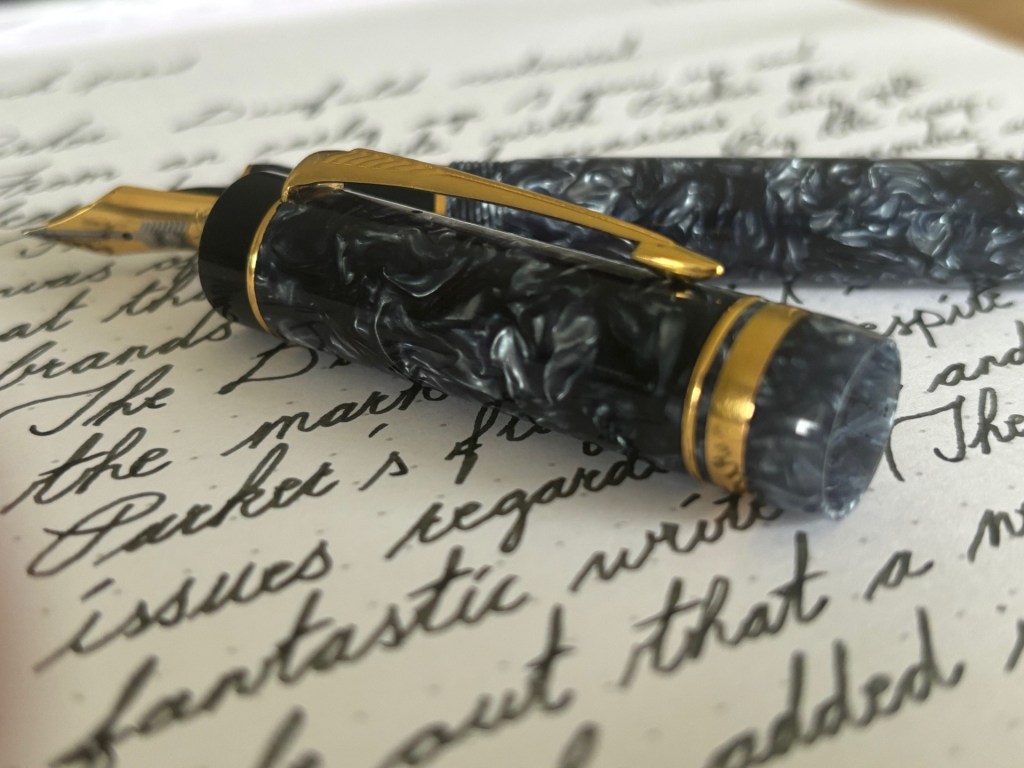
The body is constructed from solid rods of a durable acrylic called methyl methacrylate, complemented by a trim of heavily plated 23-karat gold. The blue marble color looks chic and is very beautiful. The round black grip is very comfortable and the distance to the paper, taking into account the length of the nib, allows me to write with the pen in a relaxed way. You need seven turns to remove the grip from the barrel.
The Duofold employs a cartridge/converter system that adheres to Parker’s proprietary standards, which means standard international cartridges are not compatible with it.
I want to come back to the grip, something worries me here. My Duofold only has one gold trim on the nib side. When I compare with pictures on the internet, I notice that the grip of a centennial has two gold trims. The grip of the Duofold only has a single gold trim as from 1996, being the MKII. So my suspicion is that my grip is not a MKI grip in any case. Apparently, the nibs of the MKI and MKII can also be exchanged with each other.
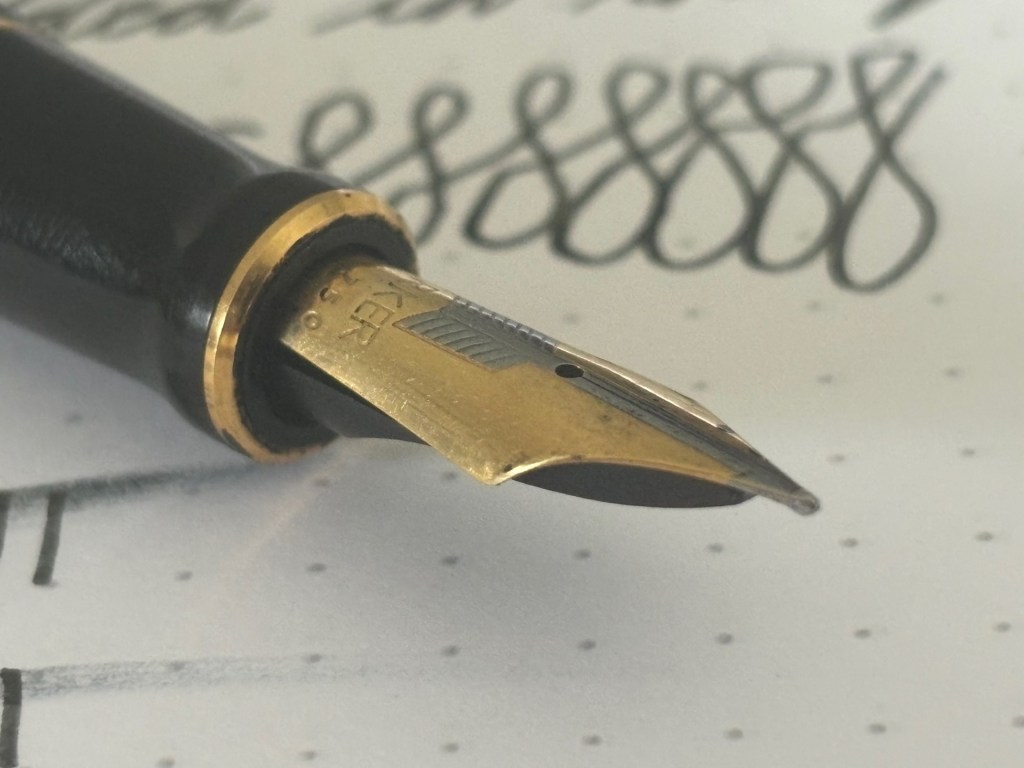
Perhaps the seller, consciously or not, has replaced the grip of the centennial with another, a more recent one. Here I am with a centennial that is not really a centennial anymore, confrontational and disappointing. I should have done my research before buying, at least I learned a wise lesson.
The Duofold has a gold nib with ruthenium (iridium) nib. The two-tone nib is engraved with the Parker brand name, ’18K’ and ‘750’. The ruthenium arrow on the nib is a nice detail. The feed is made of black plastic. Both nib and feed can be removed.
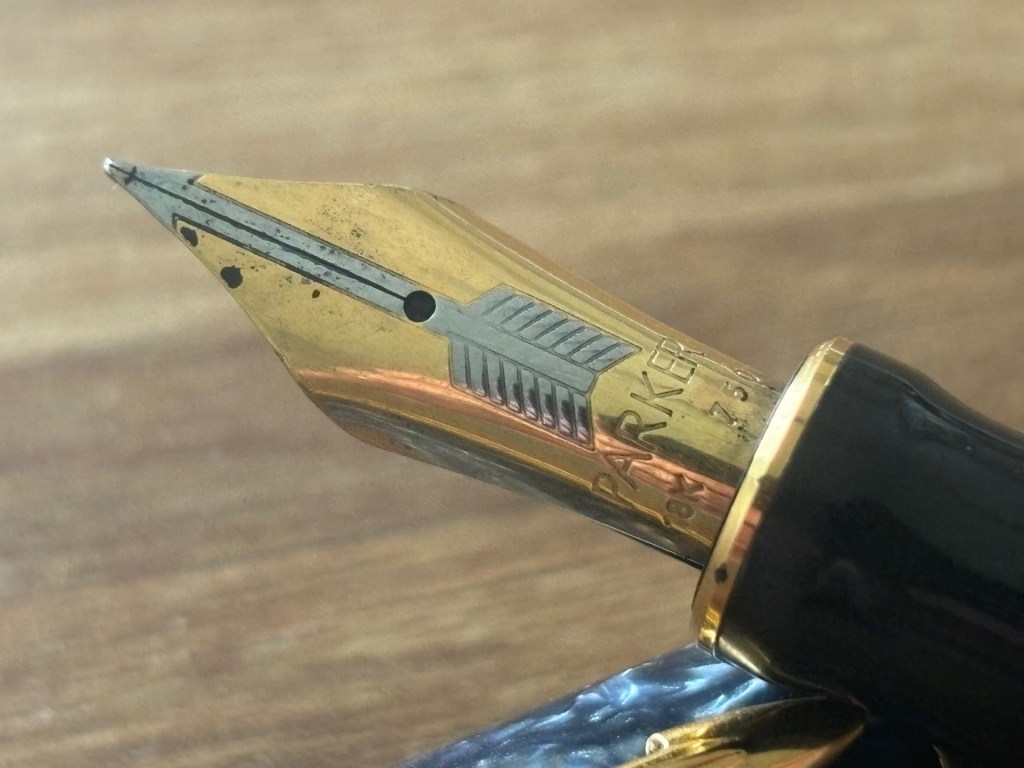
Regarding the writing performance, purchasing a second-hand fountain pen often means it may have been molded by a right-handed user. This shaping of the nib can influence the writing experience. While not necessarily drastic, it is noticeable that writing with the right hand using this Duofold is smoother and more consistent.
Left-handed also works well, but you really have to hit the nib correctly on paper with the right angle of attack to avoid any problems. So it becomes difficult to judge writing performance. For the right-handed in this case super. For the left-handed, the performance is a bit less. The good advice I received from a fellow pen enthusiast (Danny from Chronicles of a fountain pen) is to have the pen treated by a goldsmith.

I ponder whether to evaluate this pen for what it is, what it should be, or what it could become. In my view, it’s an excellent pen with significant potential, even for a left-hander. Despite minor critiques about the grip and nib, it writes beautifully. I acknowledge that this pen might not fully embody a Parker Duofold Centennial. Consequently, I remain open to the possibility of acquiring a new Parker Duofold in the future.

Waterman C/F
One pen is inked while another is cleaned and stored; such is the cycle of my pen rotation. This means my Parker Duofold will be succeeded by the next on the list: a Waterman C/F. This Waterman is a gem, with a gold nib and silver accents, a true vintage piece. I’m eager to fill it with ink and put it through its paces.


 Peacock pens
Leave a reply to Wrap up May ’24 – Peacock pens Cancel reply